
Understanding generative AI
This chapter teaches understanding generative ai through a controlled fictional workplace case. You will leave with a named artefact, a reproducible method and explicit evidence for an independent reviewer. Read the concept first, then reproduce the case in your own workbook or project file.
- Explain when understanding generative ai is useful and what can go wrong.
- Apply the technique to the evidence and constraints in the worked case below.
- Produce and verify: A human-reviewed response set, triage log and list of unsupported claims..
1 · Principles and terminology
AI, automation and generative AI
Learn
Artificial intelligence (AI) is a broad category of computer systems that perform tasks associated with perception, prediction, language or decision support. Traditional automation usually follows specific instructions: for example, a payroll spreadsheet applies a formula to calculate gross pay. A predictive model estimates a quantity from previous examples, such as forecast demand. Generative AI creates new text, images, code or other output in response to an instruction. The categories can overlap, but they are not interchangeable.
A text-based generative AI assistant predicts and generates useful language patterns from its training and supplied context. It does not inspect your workplace, know your private records or verify every answer unless it has been given appropriate access and sources. Fluent wording is not proof of accuracy. Treat the output as a draft produced by a powerful assistant, not as a signed expert opinion.
Worked example
A business needs a visitor welcome message. A fixed template would insert a name and visit date into approved text. A generative assistant could draft three friendly versions for different audiences. A human should confirm dates, safety instructions and site rules before sending any version.
Practice
Choose three tasks from daily life or work. Label each one fixed automation, prediction or generative assistance. Explain why a human review is or is not necessary. Start with fictional examples such as planning a family event, summarising a made-up meeting or designing a product description.
Key takeaway
Generative AI produces plausible new content. You remain responsible for deciding whether the content is correct and appropriate.
What an AI assistant can and cannot do
Learn
A conversational AI tool can outline ideas, transform writing, explain concepts, compare alternatives, summarise supplied text and help build first drafts. Its usefulness improves when you give relevant context. It may also make up a source, misunderstand a request, miss an exception or reproduce an unstated assumption. These errors are sometimes called hallucinations, but a simpler rule works for beginners: never mistake confidence for proof.
Different tools may support web browsing, file analysis, images or connected services. Do not assume that every tool, account or session has the same access. If a task depends on a current regulation, local price, technical specification or an internal document, check that the assistant can consult the required source. Otherwise obtain the information separately.
Worked example
Prompt: "Tell me the current price of this tool." Without the exact product, region, currency and a current price source, the answer could be misleading. A stronger task would supply a verified quotation and ask: "Compare these two quotations using only the attached figures; flag missing terms."
Practice
Make a two-column table titled AI helps and Human must check. Include six tasks, such as drafting an email, confirming a legal requirement, generating quiz questions, calculating a budget and assessing a safety risk. Discuss what evidence would be needed before relying on the result.
Key takeaway
Match the level of verification to the consequences of being wrong.
Your first safe AI task
Learn
Begin with a low-risk task using information that is public, invented or created by you. Decide in advance what success looks like. A useful first activity is turning rough notes into a clear plan. This separates the input (notes and instructions), process (AI draft and revision), and output (your checked final plan).
As you work, compare the response with your original notes. Check whether it changes any fact, invents deadlines or adds a person who was never mentioned. If the result is too long or too formal, ask for a focused revision. The assistant can revise text quickly, but the person submitting or publishing it owns the final decision.
Worked example
Fictional notes: "Team clean-up Friday 14:00. Bring gloves. Meet at front gate. Sort recyclable material. Finish by 15:30." Prompt: "Turn these notes into a friendly five-line invitation. Preserve every fact exactly and do not invent contact details." The review step is to compare every factual detail in the response against the notes.
Practice
Write five invented facts about a community activity. Ask a text assistant for a short announcement, then mark every sentence supported, rewritten but accurate or added without evidence. Revise the prompt to remove unsupported details.
Key takeaway
Start with manageable, verifiable tasks before trusting AI with complex work.
What you should be able to do
After studying this chapter, explain the essential reasoning to a colleague, produce a small practical example without looking at the notes, and identify which evidence you would verify before relying on the result. Keep your practice output so you can compare it with the worked example.
2 · Worked case: understand the decision
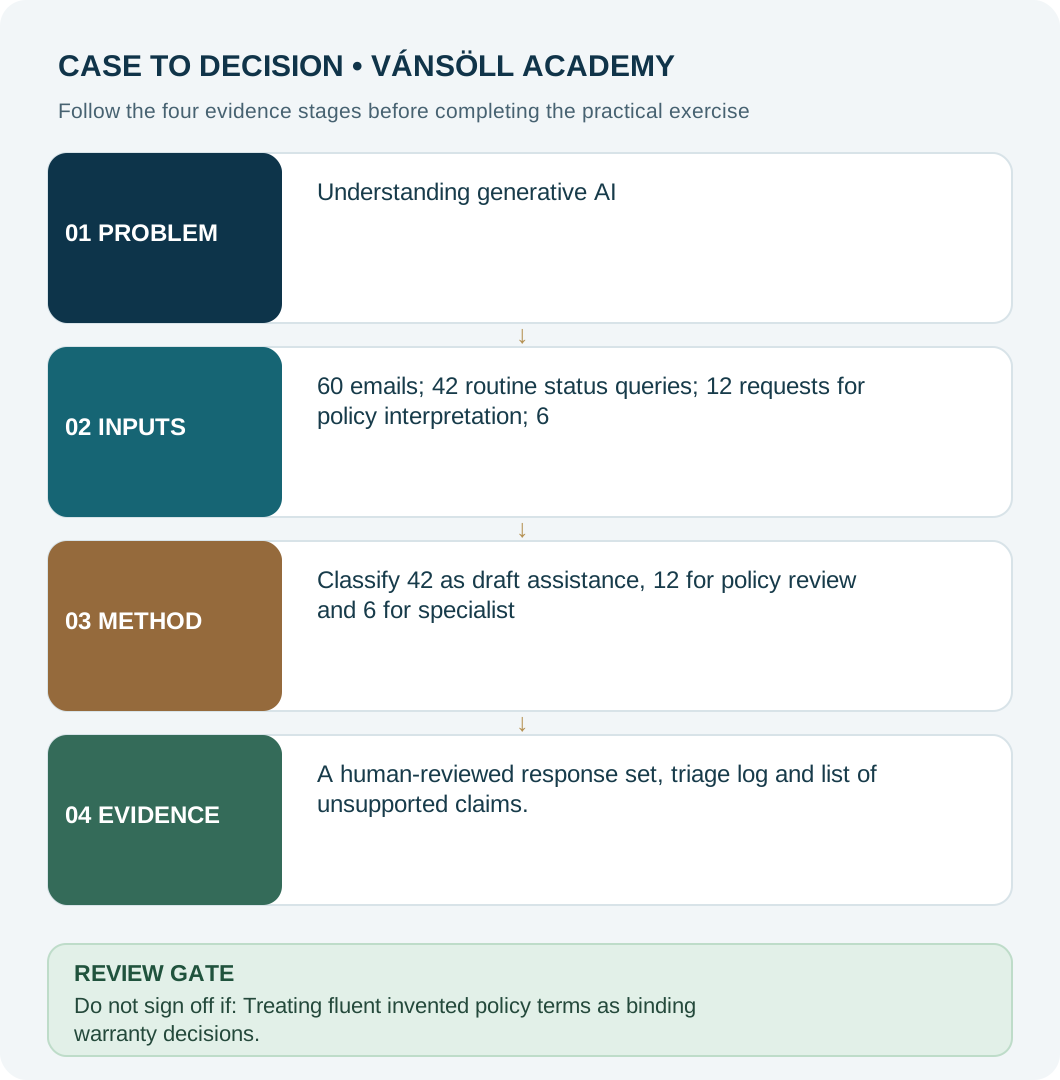
The situation: A customer-support team wants to draft responses to 60 warranty queries without inventing claim approvals. This is a deliberately fictional training exercise. The figures and facts are inputs to a decision, not conclusions you can copy to a real project without checking source documents.
| Evidence component | Training inputs or rule | Control question |
|---|---|---|
| Purpose and scope | A customer-support team wants to draft responses to 60 warranty queries without inventing claim approvals. | Is the deliverable and intended value explicit? |
| Measured data | 60 emails; 42 routine status queries; 12 requests for policy interpretation; 6 complaints. | Which figures are verified and which are assumptions? |
| Required method | Classify 42 as draft assistance, 12 for policy review and 6 for specialist handling; AI creates drafts but never decides eligibility. | Can another learner reproduce the reasoning? |
| Acceptance evidence | A human-reviewed response set, triage log and list of unsupported claims. | Would this survive independent checking? |
Work through the decision, rather than guessing
- Define the question. Restate the case as a testable decision. For this chapter it concerns understanding generative ai, not merely whether work was done. Explicitly note what is included and excluded.
- List the data. Enter each factual input separately: 60 emails; 42 routine status queries; 12 requests for policy interpretation; 6 complaints.. Where an input is ambiguous, flag it instead of silently replacing it.
- Apply the technique. Classify 42 as draft assistance, 12 for policy review and 6 for specialist handling; AI creates drafts but never decides eligibility.. If the technique involves a formula, retain both the formula and the numerical result. If it is qualitative, retain the decision criteria, owners and date.
- Interpret and check. Compare your provisional conclusion with the required output: A human-reviewed response set, triage log and list of unsupported claims.. Ask whether the decision still holds if a key constraint changes.
Draft with quoted policy clauses and require owner approval. The reason this is preferable in this case is that it follows the identified method and keeps the decision tied to verifiable inputs. A reviewer should see what was known, what was assumed, and which authority would act on the recommendation.
3 · Professional application and judgement
What a competent practitioner does: Classify 42 as draft assistance, 12 for policy review and 6 for specialist handling; AI creates drafts but never decides eligibility.. A recommendation should be proportionate to the amount of uncertainty: irreversible financial, safety or contractual decisions require stronger evidence than a reversible internal draft.
Common failure mode: Treating fluent invented policy terms as binding warranty decisions.. This mistake may give the appearance of progress while hiding an unresolved assumption. Catch it during review by tracing the final output backwards to its underlying evidence and checking dates, owners, units and approvals.
Challenge the recommendation. Consider what would happen if an input were late, incomplete, inconsistent with an approved baseline or based on an outdated revision. Decide which part of the conclusion must change and which part remains valid. Do not change the historical source record simply to make the reported outcome look cleaner.
Quality of evidence. A screenshot, recollection or unreferenced number may support an investigation but is rarely sufficient on its own for formal acceptance. Keep the approved source, the calculation or evaluation notes, the authorising decision and the final deliverable together so an independent reviewer can follow the chain.
4 · Independent practical assignment
Task: Re-create the case using the stated inputs and produce A human-reviewed response set, triage log and list of unsupported claims.. Use a spreadsheet, structured one-page register or short decision memo as appropriate. Add a version number, date, author, source references and a clearly labelled assumption list.
| Deliverable part | What to demonstrate |
|---|---|
| Inputs | Reproduce all case data and mark missing or assumed entries. |
| Working | Show calculations, logical dependencies or decision criteria in a reproducible sequence. |
| Conclusion | State what the evidence supports, and distinguish that from what is not yet known. |
| Review | Test one changed assumption and explain the consequence for your recommended action. |
Self-check before you continue: (a) Can a colleague reproduce the conclusion? (b) Is every datum traceable to its source or labelled as a training assumption? (c) Would the proposed action remain within the stated approval and safety constraints? (d) Is the evidence filed with the result? The grouped learning checkpoint follows two chapters, not every page.
Further study: This is original Vánsöll Academy training material using general professional project-management and spreadsheet practices. industry publications (where relevant) and official Excel documentation may be consulted separately. No licensed third-party diagrams or chapter text are reproduced in this example.